Architecting for Alpha: Driving Enterprise Valuations with Intent-Driven AI Over the Next 2-4 Years
For private equity boards and deal-side technology leaders, the technology mandate over the next 2-4 years is clear: drive higher multiples. However, the current industry fixation on 'agentic AI' is an evolutionary dead end.
For private equity boards and deal-side technology leaders, the technology mandate over the next 2-4 years is clear: drive higher multiples. However, the current industry fixation on “agentic AI”—dropping autonomous agents into existing legacy software—is an evolutionary dead end that threatens to trap capital in depreciating operating models.
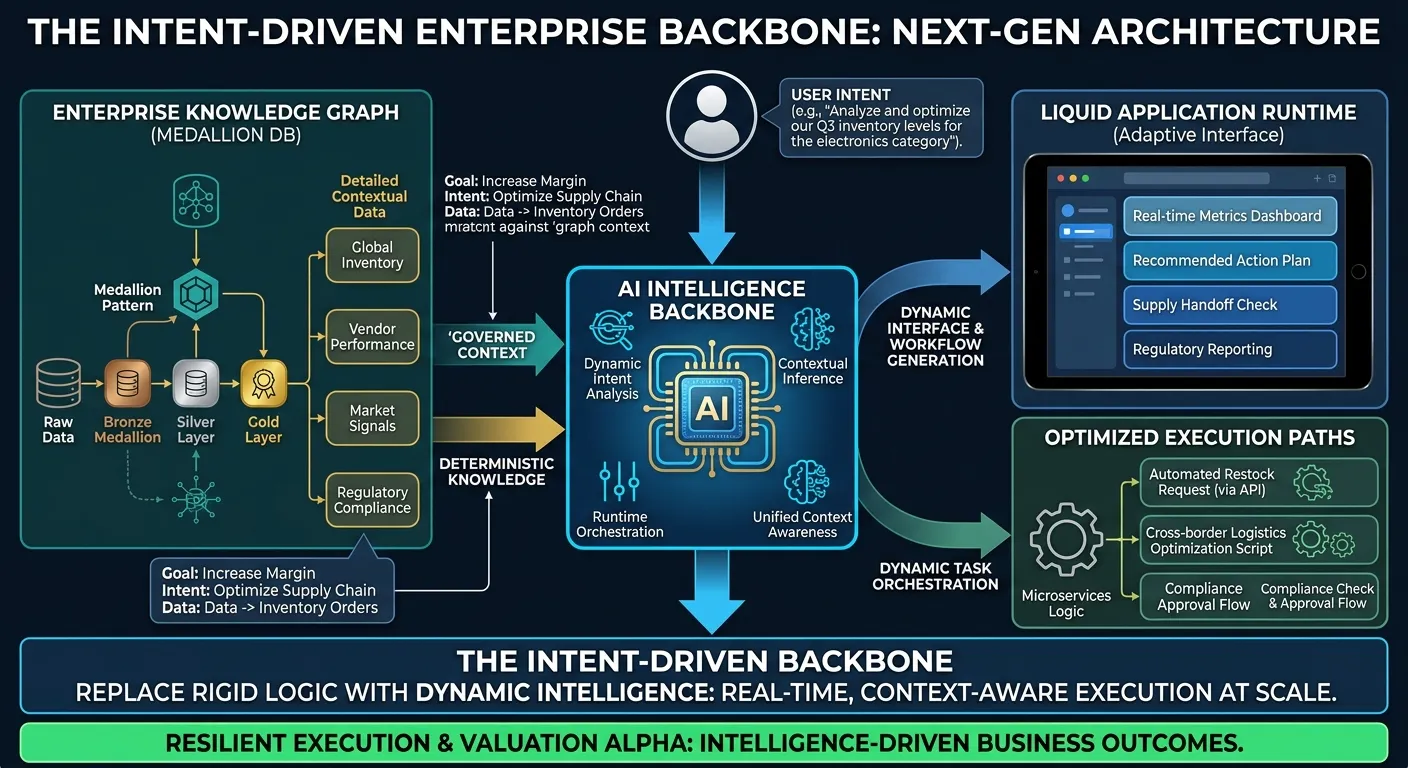
To achieve true alpha and scale valuations, portfolio companies must move beyond the illusion of the “agentic workflow” and transition to an Intent-Driven Enterprise Backbone.
Here is why the architecture of the next two to four years looks fundamentally different, and how it dictates portfolio valuations.
The Trap: The Math of “Agentic” Failure
Today’s enterprise software relies on deterministic rails—rigid, step-by-step business logic housed in CRM and ERP applications. Currently, technologists are building AI agents to navigate these existing applications.
The math behind this approach is fundamentally flawed. When you deploy an AI agent with a 95% success rate across a 20-step legacy workflow, compounding probabilities dictate that the overall success rate plummets to roughly 36%. Relying on autonomous agents to click through legacy SaaS applications is not a viable strategy for scaling a mid-market acquisition. It introduces massive operational friction and brittle execution.
The Solution: The Intent-Driven Backbone
Instead of forcing AI to operate inside rigid applications, the enterprise of the near future will use AI as the operational backbone itself. This shift requires two critical architectural pivots:
1. Context Engineering over Code Generation (The Medallion Graph)
AI cannot orchestrate a business without deep, deterministic context. The transition requires abandoning siloed application databases in favor of an Enterprise Knowledge Graph. By combining a Medallion data architecture (where raw data is progressively refined into a pristine “Gold” layer) with a Graph Database, companies create a traversable semantic layer. This gives the AI backbone the exact relationships and operational context needed to execute complex intents securely and accurately, eliminating the hallucination risks that plague standalone agents.
2. Liquid Application Runtimes
As the AI backbone takes over orchestration, the fixed-UI application layer dissolves. Instead of employees logging into static SaaS platforms, the system uses Intent-to-Execution (I2E) frameworks to capture the business goal and dynamically generate the necessary interface, data visualizations, and microservices in real-time.
The 2-4 Year Valuation Playbook
For private equity, this architectural shift fundamentally alters how target companies are evaluated and how value is created post-acquisition:
- The Collapse of Seat-Based SaaS: Portfolio companies whose moats rely on per-seat human software licenses will see their valuations compress. The transition to an Intent-Driven backbone removes humans from the execution loop, collapsing traditional SaaS economic models.
- Context as the New Moat: Valuations will increasingly hinge on a company’s data architecture. A target company that can rapidly structure its proprietary data into a unified Medallion Graph holds significantly more value than one trapped in legacy relational silos.
- Agile Roll-Ups: An Intent-Driven AI backbone allows for unprecedented speed in M&A integrations. Because the architecture relies on dynamic liquid runtimes rather than hard-coded API integrations between legacy systems, newly acquired bolt-ons can be mapped into the master graph and optimized in a fraction of the traditional time.
The next wave of valuation alpha will not come from using AI to make legacy processes 10% cheaper. It will come from fundamentally re-architecting the enterprise to operate at the speed of intelligence.
References & Industry Consensus
The strategic shift away from basic agentic workflows and toward intent-driven infrastructure is echoed by leading researchers and industry executives:
- The Arithmetic of Compounding Errors: DeepMind CEO Demis Hassabis and leading AI researchers have highlighted the mathematical fragility of multi-step AI agents. Navigating complex legacy workflows introduces “compound interest in reverse,” validating the need for centralized, context-aware AI backbones over linear agentic steps.
- The Collapse of Seat-Based Economics: Microsoft CEO Satya Nadella and broader market analysts are signaling the decline of traditional Software-as-a-Service (SaaS). As AI automates execution, the per-seat licensing model breaks down, requiring a shift toward “intelligence-as-an-outcome” valuations.
- The Obsolescence of the Fixed UI: Salesforce leadership, including Marc Benioff, is pointing toward a future without static interfaces. The next generation of enterprise software will feature dynamic, AI-generated runtimes tailored to the user’s immediate intent.
- The Governance Paradox: Research from Yale’s Jeffrey Sonnenfeld and MIT Sloan emphasizes that dropping autonomous agents into unprepared corporate structures creates severe regulatory and operational risks. Robust data engineering—specifically structured knowledge graphs and semantic layers—is the mandatory prerequisite for secure AI execution.
Tags: #PrivateEquity #EnterpriseArchitecture #IntentDrivenAI #AgenticAI #ValueCreation